Your AI Handles the Routine.
We Handle the Exceptions.
Human-in-the-Loop Operations for Enterprise AI.
AI systems automate business processes, but some decisions still require human judgment. Hybrius provides managed operational support to review exceptions, validate outcomes, coordinate escalations, and keep AI-enabled workflows moving.

Automation Doesn't Eliminate Exceptions.
AI can process routine tasks, interpret information, and generate recommendations. But uncertain results, missing information, policy exceptions, and unusual situations still require review. When these cases have no clear owner, they create delays, manual work, and operational risk.
Low-Confidence Decisions
AI outputs that need verification before action.
Incomplete or Conflicting Information
Missing data, inconsistent records, or ambiguous inputs.
Policy and Business Rule Exceptions
Situations requiring client-defined approval or additional review.
Escalations and Edge Cases
Complex situations that fall outside standard automation workflows.
The challenge isn't simply building smarter AI. It's creating a reliable operating model for the work AI cannot finish.
Connect Your AI Workflows to Human Operations.
Hybrius works with clients to establish secure, structured ways for unresolved AI cases to reach a trained operations team.
API-Based Integration
Approved interfaces can submit structured exceptions to a defined workflow.
Workflow and Automation Platforms
Exceptions can be routed through existing orchestration and business process systems.
Ticketing and Case Management
AI-generated issues can enter a shared queue with status, ownership, and escalation tracking.
Controlled Manual Intake
For early pilots, authorized users can submit cases through an agreed process without complex integration.
The appropriate integration method depends on the client's systems, data policies, and operational requirements.
From AI Exception to Resolved Outcome.
Detect & Route
A client's AI or business workflow identifies a case requiring additional review.
Triage & Classify
Hybrius analysts assess the case against approved categories, priorities, and handling procedures.
Review & Validate
The operations team examines available information, verifies required details, and follows client-approved decision rules.
Resolve or Escalate
Authorized cases are resolved within defined permissions. Cases requiring specialist judgment or approval are escalated to the client's designated team.
Document & Improve
Actions, decisions, and outcomes are recorded for reporting, quality review, and potential workflow improvement.
Feedback Loop
Documented outcomes and exception patterns support client-approved workflow refinement. Hybrius does not automatically retrain customer AI models.
Client Authority
Clients retain authority over their business policies, approval thresholds, and final decisions requiring designated oversight.
One primary service. Three supporting capabilities.
AI Exception Handling as a Managed Service
Human-in-the-loop review, exception triage, case resolution, escalation, and operational reporting for AI-enabled workflows.
Workflow Automation & Integration
Connect AI exception queues with business workflows, ticketing platforms, and approved enterprise systems.
Operational Monitoring & Case Management
Track exception volumes, case status, escalation patterns, and operational performance.
Continuous Improvement Support
Use documented exception patterns and operational insights to identify opportunities for process refinement and automation improvements.
Capability scope is designed around each engagement. Integration and reporting approaches are built to client requirements — not offered as prebuilt packaged software.
See AI Exception Handling in Action.
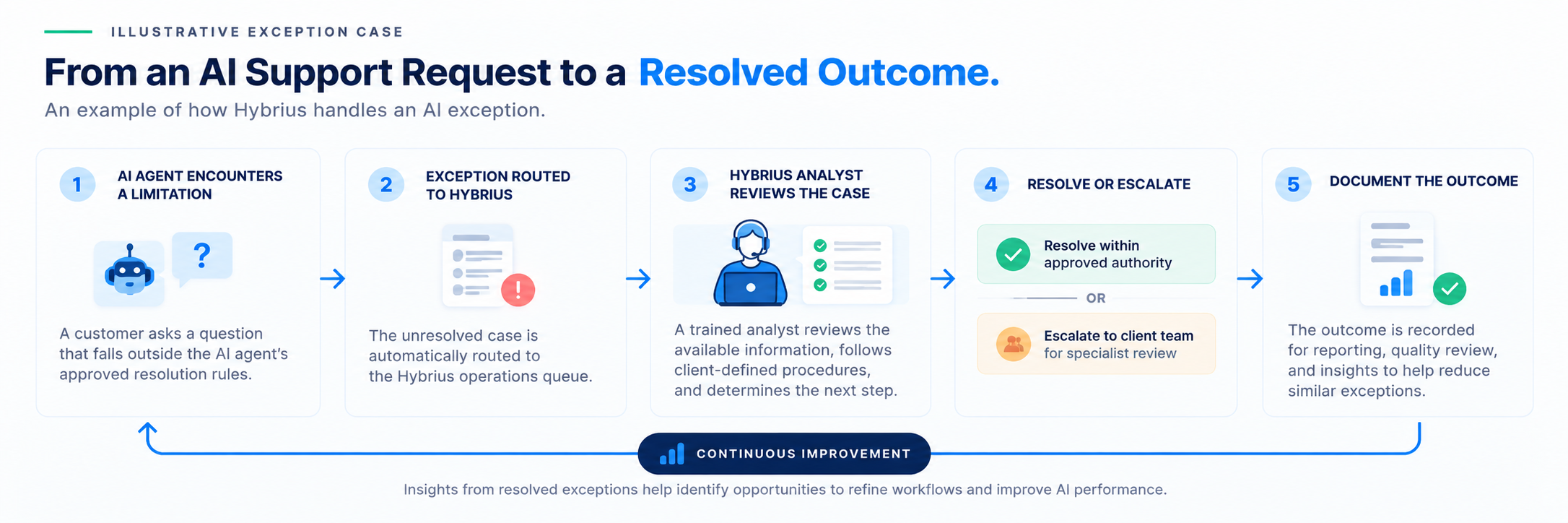
Imagine an AI customer support agent encounters a request it cannot resolve within its approved rules. Hybrius can help establish a process for routing that exception to trained analysts, reviewing the case, resolving authorized tasks, or escalating decisions that require client approval.
Swipe to view the full example.
Illustrative scenario only. Exception routing, analyst responsibilities, resolution authority, and integration methods are established with each client. Automated routing is available where supported by the agreed workflow and integration design.
Start Small. Prove the Model. Scale with Confidence.
Identify the client's AI workflows, exception categories, operational pain points, and approximate case volumes.
Define intake methods, handling procedures, approval boundaries, escalation paths, and reporting requirements.
Launch a controlled pilot with a defined workflow, limited case categories, agreed staffing, and client-approved operating procedures.
Evaluate exception volumes, turnaround time, escalation frequency, quality, and operational efficiency.
Expand coverage, supported workflows, and staffing based on pilot findings and mutually agreed service requirements.
Pilot scope, timeline, pricing, staffing, and service levels are defined during discovery.
US-led. Globally delivered.
Hybrius combines US-based client leadership and enterprise technology expertise with a flexible global delivery strategy. Our operating model is designed to support structured case handling, clear escalation paths, and accountability across distributed teams.
US-Based Accountability
Client engagement, solution design, and service governance led through Hybrius's US organization.
Manila Delivery Strategy
A developing offshore delivery capability intended to support trained analyst operations and scalable service coverage.
Client-Defined Controls
Access permissions, handling procedures, escalation rules, and data requirements established for each engagement.
Flexible Coverage
Staffing and service windows designed around client needs and agreed contractual terms.
Offshore delivery access is established per engagement under client-defined controls — never automatic or unrestricted.
Where Human Oversight Makes AI More Reliable.
Customer Support AI
An AI assistant cannot confidently resolve a customer request. The case is routed for human review, follow-up, or escalation.
Document Processing
An automated system encounters missing or conflicting information. A reviewer validates the available records and follows an approved exception procedure.
Enterprise Workflow Automation
An automated approval or processing workflow encounters a policy exception. The case is assigned for authorized review and escalation.
Operational Monitoring
An AI monitoring system identifies an uncertain event. An analyst evaluates the available evidence and follows a client-approved response procedure.
Illustrative scenarios — not completed Hybrius customer projects. Hybrius does not provide clinical diagnoses, financial approvals, or autonomous safety-critical decision-making.
Manage AI Exceptions with Operational Accountability.
A managed AI operations service should be measured using agreed operational metrics. Example measures include:
Exception Volume
The number of AI-generated cases routed for review over a defined period.
Average Time to Resolution
How long exceptions take from intake to resolved outcome.
Escalation Rate
The share of cases escalated to client-designated teams.
Case Backlog
Open cases awaiting review or resolution at a given time.
Quality Review Results
Outcomes of structured quality checks on completed cases.
SLA Adherence
Performance against contractual service levels, where they exist.
Reporting measures and service targets are established based on each client's operating model and engagement scope.
Your AI Is Ready to Scale.
Is Your Operations Model?
Whether you're deploying AI agents, automating enterprise workflows, or managing existing AI systems, Hybrius can help you explore a structured approach to exception handling and human oversight.
Tell us about your AI workflow, current exceptions, and operational challenges. We'll discuss potential next steps.